
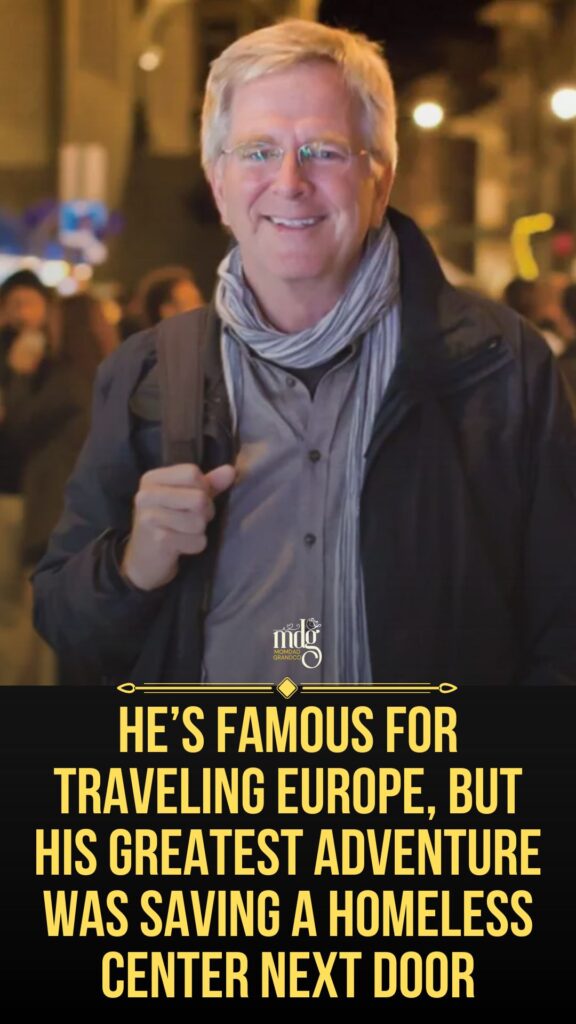
We know Rick Steves as the friendly face of public television, the man with the backpack and the Europe guidebooks who taught us how to navigate the canals of Venice, the museums of Paris, and the hills of Tuscany. He has spent a lifetime teaching Americans how to be “temporary locals” in foreign lands, encouraging us to look beyond tourist traps to find the authentic heart of a place.
But recently, the travel guru embarked on a journey that didn’t require a passport. It didn’t even require a plane ticket. It happened right in his own backyard in Snohomish County, Washington, and the destination was a humble building that most people drive past without ever noticing.
In a story that is warming hearts across the nation this winter, Rick Steves stepped up to save the Lynnwood Hygiene Center—a critical lifeline for the unhoused—just weeks before it was set to close its doors forever.
This isn’t just a story about a celebrity writing a check. It is a story about visibility, the definition of “home,” and why a hot shower is sometimes the most powerful tool for restoring human dignity.
The Invisible Crisis Next Door
To understand the magnitude of this act, we must first look at the reality of homelessness in the Pacific Northwest. It is a region known for its beauty, but also for its relentless, bone-chilling dampness. For those living without shelter, the cold isn’t just uncomfortable; it is a constant, gnawing threat.
In Lynnwood, Washington, there was one sanctuary: The Lynnwood Hygiene Center.
Operated by the Jean Kim Foundation since 2020, this facility was more than just a building. For the nearly 700 unhoused residents who relied on it, it was the only place in the area where they could perform the basic human acts the rest of us take for granted.
It was the only place to get a free hot shower.
It was the only place to use a clean restroom.
It was the only place to wash clothes.
It was the only place to sit indoors, out of the rain, and eat a hot meal in peace.
Since opening, the center has provided over 52,000 showers. That is 52,000 moments of relief. 52,000 moments where a human being could wash away the grime of the streets and feel like themselves again.
But in late 2025, this sanctuary faced an existential threat. The property owner announced plans to sell the building. The price tag was $2.5 million—a figure far beyond the reach of a small non-profit foundation.
The “Goodbye Party” No One Wanted
The news of the potential sale sent shockwaves through the vulnerable community that depended on the center. For the unhoused, stability is a rare and precious commodity. Losing the hygiene center meant losing their last tether to hygiene and health.
Sandra Mears, the executive director of the Jean Kim Foundation, found herself in a heartbreaking position. Instead of planning for the future, she was told to prepare for the end.
“I didn’t want a goodbye party,” Mears admitted later. The thought of telling hundreds of people—families, veterans, the elderly—that the doors were locking was devastating.
As November rolled around and the wet Washington winter began to set in, the outlook was grim. Developers were circling. The clock was ticking. It seemed inevitable that the building would be sold, likely bulldozed or repurposed, leaving the “invisible people” of Lynnwood out in the cold.
A Traveler’s Epiphany
Rick Steves lives in Edmonds, a picturesque waterfront town not far from Lynnwood. Despite being a local, and despite his deep involvement in community philanthropy, he admitted that he had no idea the hygiene center even existed.
He stumbled upon the news in a local online publication. He read about the impending closure. He read about the panic of the staff and the despair of the clients.
And then, he did something that defines his philosophy on travel: he got curious.
Steves admitted to NPR that initially, he didn’t even understand what a “hygiene center” was. Why was a specific building needed just for showers?
“I realized, oh my goodness, there’s an invisible community with an invisible center helping invisible people,” Steves said. “And it’s not right. It needs to be kept alive.”
The concept of “invisibility” struck a chord. Throughout his career, Steves has preached that travel is fatal to prejudice. He teaches that when we travel, we see people for who they really are. But here, in his own county, was a group of people who had become invisible to their own neighbors.
He reflected on his own youth, backpacking through Europe on a shoestring budget. He remembered the desperate feeling of needing a shower, of needing to wash clothes in a sink, of just wanting to feel clean. He realized that hygiene is the first step toward confidence. It’s the first step toward a job interview. It’s the first step toward re-entering society.
The Best $2.25 Million Ever Spent
Rick Steves is a successful businessman, but $2.25 million is a massive sum for anyone. However, once he understood the stakes, the decision was simple.
He didn’t launch a GoFundMe. He didn’t ask for a plaque with his name on it. He simply called the foundation and said, “Let’s fix this.”
Steves purchased the building for $2.25 million. He then effectively handed the keys over to the Jean Kim Foundation, ensuring they could operate rent-free, forever.
The closure was canceled. The eviction notices were torn up.
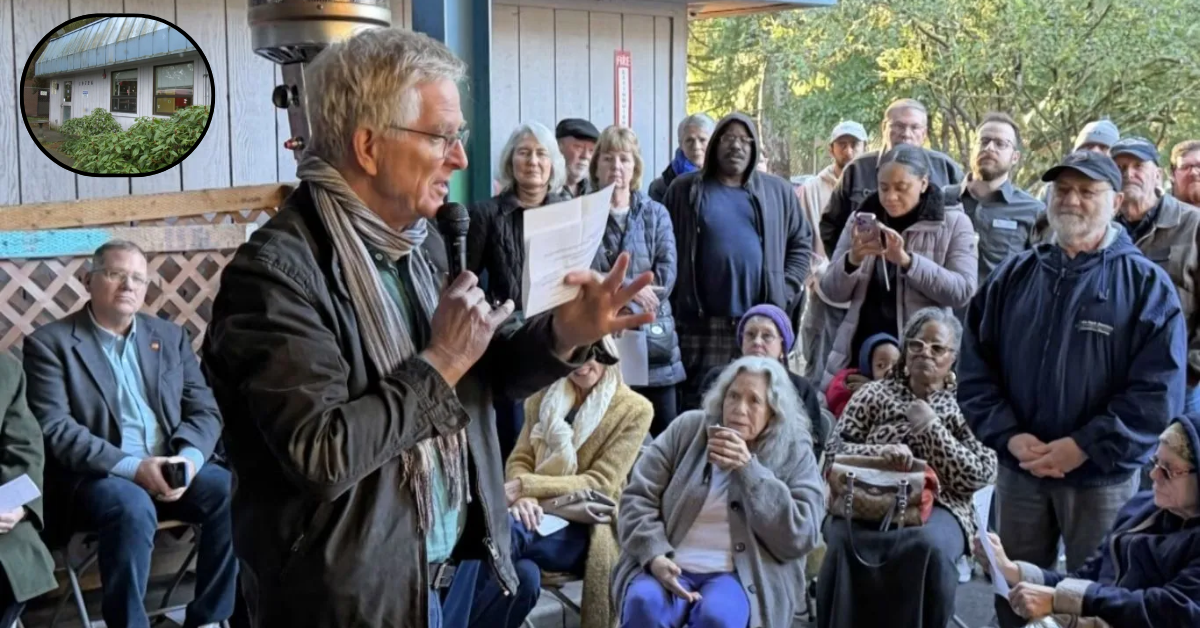
A few days later, a gathering was held at the center. It wasn’t the “goodbye party” Sandra Mears had feared. It was a victory party.
On a table sat a large sheet cake. Written in bright red icing were the words: “FAIT ACCOMPLI.”
It is a French phrase meaning “an accomplished fact”—a done deal. The building was theirs.
At the gathering, Steves spoke to the staff and the clients. He was humble, deflecting praise. He later described the purchase as the “best $2.25 million” he could imagine spending. For a man who has stayed in the world’s finest hotels and eaten in the world’s best restaurants, placing the value of a community shower above all else speaks volumes about his character.
The Ripple Effect of Kindness
One of the most beautiful things about bold acts of generosity is that they are contagious.
When the community learned that Rick Steves had saved the building, they didn’t sit back and say, “Well, he’s got it covered.” Instead, they were inspired to help with the operations.
Steves bought the shell, but the community wanted to fill it.
In the wake of the announcement, local members of the community donated an additional $400,000.
According to Sandra Mears, these funds are a godsend. They will be used for much-needed building repairs, deferred maintenance, and expanding the services offered. They can now fix the plumbing that runs 52,000 showers. They can upgrade the laundry machines. They can buy better food.
Because of this combined effort—one man’s capital and a community’s heart—the center is projected to provide:
- 10,000 showers annually
- 16,000 hot meals annually
- Countless hours of safety for 700 vulnerable neighbors
“What Kind of Society Are We?”
While the story is heartwarming, Rick Steves is not one to let us off the hook easily. He is a thoughtful critic of how we handle social safety nets.
In posts shared on Bluesky and other social media platforms following the purchase, Steves made a poignant observation. He expressed gratitude that he could help, but anger that he had to.
He argued that basic human needs—showers, warmth, food—should not be dependent on the whims of a wealthy donor stepping in at the last minute. They should be public priorities.
“If we don’t have [$2.25 million] for a whole county to give homeless people a shower and a place to get out of the rain and a place to wash their clothes, what kind of society are we?” Steves asked.
It is a question that lingers. Why was this essential service allowed to reach the brink of extinction? Steves used his platform to remind us that while charity is beautiful, justice is better. We should build a society where hygiene centers are funded because they are necessary, not because a celebrity happened to read a local blog post.
The Human Impact: “A Community Treasure”
For the people on the ground, the philosophy matters less than the reality of the open door.
Al, a frequent visitor to the center, spoke to local news crews with visible emotion. For Al, the center isn’t a political statement; it’s his morning routine. It’s his dignity.
“Rick Steves is a community treasure,” Al said. “Not just for Snohomish County, but for all of Washington.”
But perhaps the real treasure is the perspective shift.
By saving the center, Steves forced the community to look at it. He forced his neighbors to acknowledge that 700 people need this place. He took the “invisible people” and put them in the spotlight, not to shame them, but to say, “You belong here. You deserve to be clean. You deserve to be warm.”
The Lesson for Us All
As we enter a new year, the story of the Lynnwood Hygiene Center serves as a powerful resolution for us all.
We can’t all drop millions of dollars to buy a building. But we can all do what Rick Steves did first: We can stop being oblivious.
We can read our local papers. We can find out where the “invisible” centers are in our own towns. We can ask ourselves what we are walking past every day.
Maybe you can’t buy the building, but you can donate a bottle of shampoo. You can volunteer to fold towels. You can advocate at a city council meeting for better funding for homeless services.
Rick Steves has spent decades telling us to “Keep on Travelin’.” Now, he’s telling us to “Keep on Caring.”
He has shown us that the most important trip we can take isn’t across the ocean. It’s across the street, to help a neighbor in need.
Thank you, Rick, for showing us the way.
Join the conversation at MomDadGradCo:
Did you know that “hygiene centers” existed? How does your community support the “invisible” neighbors? Share your thoughts and local resources in the comments below!

Leave a Reply to Donna Rose Cancel reply