

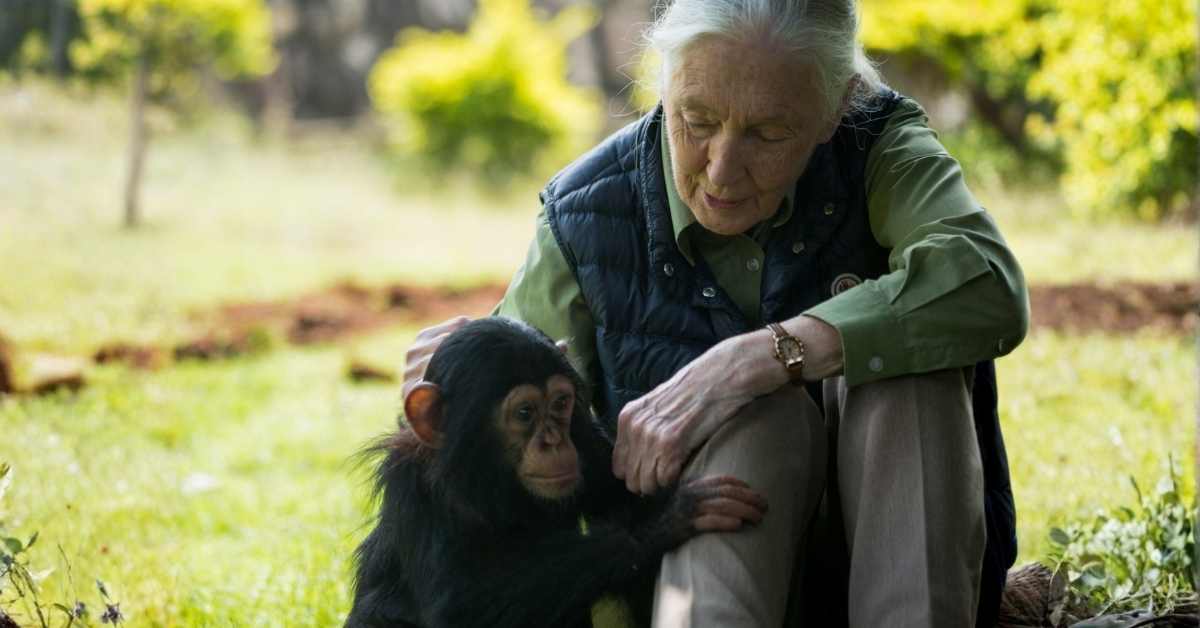
On October 1st, 2025, the world quietly lost one of its greatest souls.
Dr. Jane Goodall – beloved ethologist, global conservationist, humanitarian, UN Messenger of Peace, and a lifelong friend to animals – passed away in her sleep at age 91. Even in her final months, she was still doing what she had done for more than six decades: traveling, speaking, and inspiring millions to protect our planet.
To many of us, Jane Goodall was more than a scientist.
She was a reminder of what one compassionate heart can do.
She was proof that gentleness is not weakness.
She was a living example that hope – real hope – still exists.
Her life’s work didn’t just change science.
It changed humanity.
Today, we honor her life, her wisdom, and the powerful lessons she left behind for our children, grandchildren, and future generations.
A Childhood Dream That Never Let Go
Most of us had childhood dreams. Many faded with time. Jane’s never did.
She often said she was “born loving animals.”
As a little girl in England, she spent hours outside watching birds, insects, dogs, hens. There were no screens, no TV, no distractions – only curiosity.
At age four, she disappeared for hours.
Her frantic mother called the police.
Finally, she found Jane sitting silently in a hen house, waiting to see exactly how a hen laid an egg.
Instead of scolding her, her mother knelt down and said, “If you’re curious, you’ll learn so much. Just remember to tell me next time.”
That gentle support shaped her entire life.
At age eight, she read Dr. Doolittle.
At ten, she read Tarzan of the Apes.
That was the moment she said:
“I’m going to Africa. I’ll live with wild animals and write books about them.”
Everyone laughed.
It was the 1940s.
Africa seemed impossibly far.
Her family had little money.
And she was “just a girl.”
But her mother believed in her.
She told her:
“If you really want something, work hard, take opportunities, never give up – and you will find a way.”
Jane held onto those words her entire life.
Millions of people today hold onto Jane’s words in the same way.
A Groundbreaking Woman in a Man’s World
In the late 1950s, a young secretary named Jane Goodall stepped off a boat in Tanzania. She carried a notebook, a pair of binoculars, and a dream many thought was impossible.
She had no university degree.
No scientific training.
No formal background.
But she had patience, compassion, and an ability to quietly observe the world around her.
With the sponsorship of famed anthropologist Louis Leakey, Jane began her now-legendary research in Gombe, studying chimpanzees in the wild – something no woman had ever been allowed or encouraged to do.
What she discovered changed science forever:
● Chimpanzees use tools
● They have emotions
● They hug, kiss, grieve, and form deep bonds
● They show kindness – and conflict – just like humans
Her work proved something the world needed to hear:
Animals are not objects.
They are beings – deserving of respect and protection.
Her courage opened doors for generations of women in science. And she did it not with force, but with grace.
The Voice That Spoke for the Earth
Jane quickly became more than a scientist – she became a storyteller, teacher, and global advocate.
She traveled nonstop for decades, sometimes speaking 300 days a year.
Her message was simple:
We must care for the Earth.
We must protect animals.
We must protect each other.
Everything is connected.
She repeated this message to:
● presidents
● children
● CEOs
● villagers
● classrooms
● world leaders
● grandparents
● entire nations
She never stopped believing humanity could do better.
Even when forests disappeared…
Even when species vanished…
Even when the world grew louder, faster, harsher…
Jane remained hopeful.
She always believed people could change.
Her Greatest Hope: The Children of the World
Although she inspired millions of adults, Jane often said:
“My greatest hope really lies with youth.”
In 1991, she started Roots & Shoots, a youth action program that began with 12 teenagers sitting on a porch in Tanzania.
Today, it exists in 75+ countries, empowering children and young adults to create projects that help:
● people
● animals
● the environment
Jane believed young people have an ability adults sometimes forget — the ability to imagine a better world and work for it without fear or cynicism.
She said:
“When you listen to young people, when you let them lead – they change the world.”
And they are.
Every day.
Her Warning to the World
As gentle as Jane was, she never hesitated to tell the truth.
She warned that nature was suffering.
Forests were disappearing.
Animals were vanishing.
Climate change was accelerating.
And humanity’s lifestyle was harming the Earth.
She often said:
“We have not borrowed this planet from our children.
We have been stealing from them.”
But she always followed with hope:
“If we act together, we can still repair what has been damaged.”
Start Where You Are: Her Message of Local Action
Jane understood something important:
Most people feel overwhelmed by global problems.
So she encouraged small, local actions:
● clean a local stream
● plant a tree
● volunteer at a shelter
● help a neighbor
● feed a hungry child
● support a local group
● teach kindness to grandchildren
● recycle, reuse, repair
● be mindful of what we buy
She always said:
“Do the good you can… where you are.
It multiplies.”
And she believed deeply that helping others gives us hope.
Her Thoughts on Women, Equality & Dignity
Jane was a fierce advocate for women and girls worldwide.
She saw progress – especially in education – but she reminded us that equality is still a journey.
One of her favorite metaphors came from an Indigenous chief:
“A tribe is like an eagle – one wing male, one wing female.
Only when both wings are equal will the eagle fly high.”
That vision guided her work.
A Lifelong Love for Nature
Jane believed modern life had disconnected us from the world we belong to.
She worried that children grow up indoors, surrounded by screens instead of trees, birds, animals, and sunlight.
Science later proved her right – children need nature for emotional, mental, and physical health.
She encouraged every parent and grandparent to give children:
● dirt to dig in
● leaves to touch
● bugs to examine
● trees to climb
● birds to admire
● time outdoors
She said:
“A child holding an earthworm learns more than any screen can teach.”
Her Gentle Redefinition of Success
Jane felt that modern society had the wrong idea about success.
To her, the world measured success with:
● money
● power
● status
● material things
But she believed true success is simpler:
● time with family
● laughter
● simple joys
● nature
● purpose
● peace
● community
She said she had met wealthy people who were miserable — and villagers with nothing who were joyful.
Her advice:
“We need a new definition of success.
A life with meaning, kindness, and connection.”
Why She Never Lost Hope
Even at 91, Jane remained one of the most hopeful voices on Earth.
She believed in:
● the next generation
● nature’s ability to heal
● the resilience of people
● human potential
● community power
She said:
“People are tackling the impossible every day.
As long as we act – there is hope.”
Her Legacy Lives On
When asked how she wanted to be remembered, Jane said two things:
- Roots & Shoots – empowering young people worldwide
- Changing how the world sees animals – as beings with emotions and rights
But she also left one powerful reminder for all of us:
“Every single day, every one of us makes an impact.
Choose to make it a good one.”
Her life was a gift.
Her message was a gift.
Her hope was a gift.
And now, it is our turn to carry it forward – for our children, our grandchildren, and the generations yet to come.

Leave a Reply to Roxanne Avery Cancel reply