


We all have that box. Maybe it’s tucked away in the attic, or shoved under a bed. It’s filled with dusty photo albums, loose prints with curled edges, and perhaps a few unlabeled VHS tapes. We look at the smiling faces of ancestors we barely knew and we wonder: What did their laugh sound like? What was their favorite song? How did they fall in love?
For most of us, those answers are lost to time. We are left with the silence of a static image.
But for Charlie Greene, the silence wasn’t just a philosophical problem – it was a personal haunting. After suffering a devastating loss as a child and facing another potential tragedy as an adult, Charlie decided to declare war on forgetfulness.
He didn’t just want a photo; he wanted the soul behind it. And in his quest to save his mother’s stories, he built something that is now saving thousands of families from the heartbreak of lost legacies. This is the story of Remento.
The Day the World Changed
To understand the urgency behind Remento, you have to go back to September 11, 2001.
Charlie Greene was ten years old. It was a Tuesday. The sky was that crisp, impossible blue that everyone remembers. But by mid-morning, Charlie’s world had shattered. His father, Donald Freeman Greene, was a passenger on United Flight 93 – the plane that crashed in a field in Shanksville, Pennsylvania, after passengers heroically fought back against hijackers.
In an instant, Charlie’s father was gone.
In the years that followed, Charlie found himself clinging to scraps of memory. He scoured family archives for anything that could bring his dad back, even for a second.
“I was blown away that I couldn’t find a single video of my dad longer than seven seconds,” Charlie shared in a recent interview.
He found one clip: a grainy home video of his father sitting at the breakfast table, eating a bagel, mid-sentence. It wasn’t a profound speech. It wasn’t a birthday toast. It was just a man eating breakfast. But to Charlie, hearing the cadence of his father’s voice and seeing the way he moved was more valuable than gold. It was proof of life.
The Second Warning
Fast forward to 2017. Charlie was an adult, building a life, when the phone rang with the kind of news that stops you in your tracks.
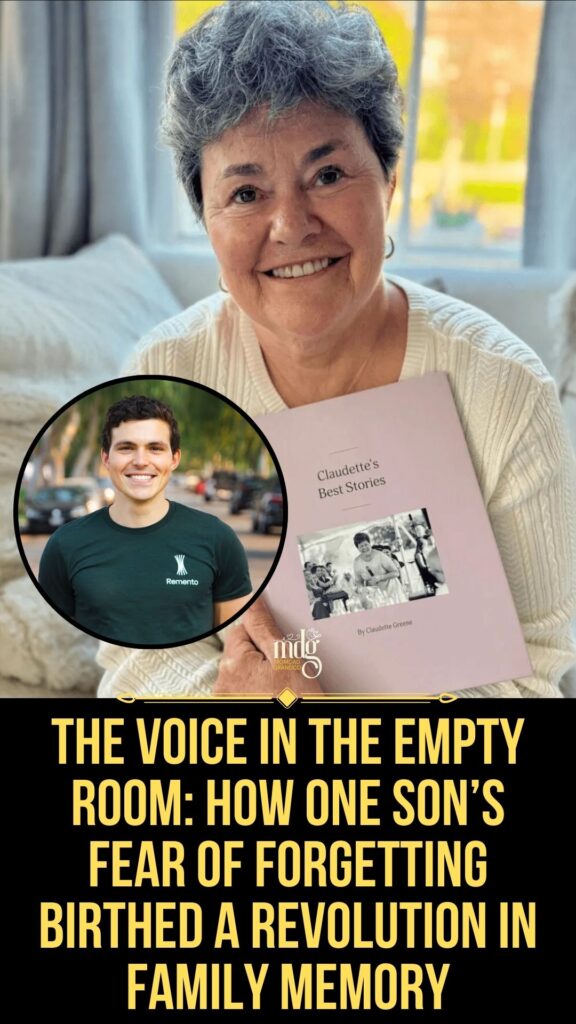
His mother, Claudette – the woman who had raised him and his sister through the grief of 9/11 – had been diagnosed with stage 3 lung cancer.
The trauma of his childhood came rushing back. The fear was palpable. I cannot lose her stories too, he thought. I cannot let my future children grow up without knowing who she is.
He went into overdrive. He did what many well-meaning children do: he bought her a “write-your-own-memoir” book. You know the ones – thick journals with questions like “What was your childhood home like?” at the top of blank pages.
He gave it to her with hope.
It sat on her nightstand. Unopened.
“Writing feels like homework,” his mother told him. She was tired. She was battling cancer. The last thing she wanted to do was sit alone in a room and write an essay about her life.
Charlie realized he had failed. He was trying to turn his mother into an author, when what he really wanted was to capture her as a mother.
The “Kitchen Table” Breakthrough
Charlie ditched the book. He tried a different approach. He grabbed his phone, sat down across from her at the kitchen table, and simply hit “record.”
He didn’t ask her to write. He asked her to talk.
He showed her an old photo. “Tell me about this day,” he said.
And the magic happened. Claudette lit up. Without the pressure of perfect grammar or penmanship, the stories flowed. She laughed. She cried. She told him about the moment she fell in love with his father. She told him about the trouble she got into as a teenager.
“It was magical,” Charlie recalled. “Hearing her laugh, seeing her stories… I realized that photos don’t capture a person’s essence like their voice does.”
In that moment, Remento was born. Charlie realized that the barrier to preserving family history wasn’t a lack of stories; it was the friction of the tools. People love to talk; they hate to write.
How Remento Changed the Game
Charlie teamed up with co-founder Alex Massonneau to turn this personal project into a platform for everyone. They built Remento on a simple premise: No writing required.
Here is how it works, and why it is bringing grown men and women to tears:
- The Prompts: The system sends a weekly email or text to your loved one with a thought-provoking question (e.g., “What was your first job?” or “Tell me about the trouble you got into in high school”).
- The Recording: They don’t have to type a single word. They simply press a button and speak their answer. They can talk while they’re gardening, having coffee, or sitting in their favorite chair.
- The Magic: Remento collects these recordings. It uses technology to transcribe them into text, but it keeps the audio.
- The Book: At the end, these stories are compiled into a beautiful, hardcover book. But here is the “killer feature”—each story in the book has a QR code. When you scan it with your phone, you don’t just read the story; you hear your loved one telling it.
It captures the laugh. The pause. The catch in the throat. The specific regional accent that you never want to forget.
The Shark Tank Moment
The idea was too powerful to stay small. In 2025, Charlie took Remento to the biggest stage in entrepreneurship: Shark Tank.
Standing in front of the Sharks, Charlie shared the story of his father and the bagel video. He shared the story of his mother’s cancer battle. By the time he finished his pitch, there wasn’t a dry eye on the panel.
Three of the five Sharks were visibly emotional. Mark Cuban, impressed by the mission and the simplicity of the product, decided to invest. It was a validation that this wasn’t just a “tech product”—it was a humanity product.
Not Just for the End of Life
While Remento was born out of a fear of loss, it has become a celebration of life.
Families aren’t just using it for aging grandparents.
- New Parents: documenting the chaos of the first year.
- Military Families: bridging the gap during deployments.
- Reunions: capturing the collective memory of a clan.
It turns out that when you ask someone a question and really listen to the answer, it strengthens the relationship right now.
“I learned things about my mom I never knew,” Charlie said. “It brought us closer together while she was still here.”
(And the happy ending? Claudette fought the cancer. She got to see her son succeed, and she got to hold the book of her own life in her hands.)
Why You Should Start Today
We often think we have time. We think we’ll ask those questions at the next holiday, or next summer, or “when things slow down.”
But if Charlie Greene’s story teaches us anything, it is that time is a thief. The “bagel video” is precious, but it is too short.
Remento offers a way to ensure that your family’s legacy isn’t left to chance. It ensures that fifty years from now, your great-grandchildren won’t just look at a static photo of you and wonder who you were. They will scan a code, and they will hear you tell them yourself.
Preserve the voice. Preserve the story. Preserve the love.
To learn more about Charlie’s story and start your own family book, visit Remento.co
Join the conversation at MomDadGradCo:
What is the one question you wish you had asked a loved one before they passed? Share your thoughts in the comments below.
Leave a Reply