

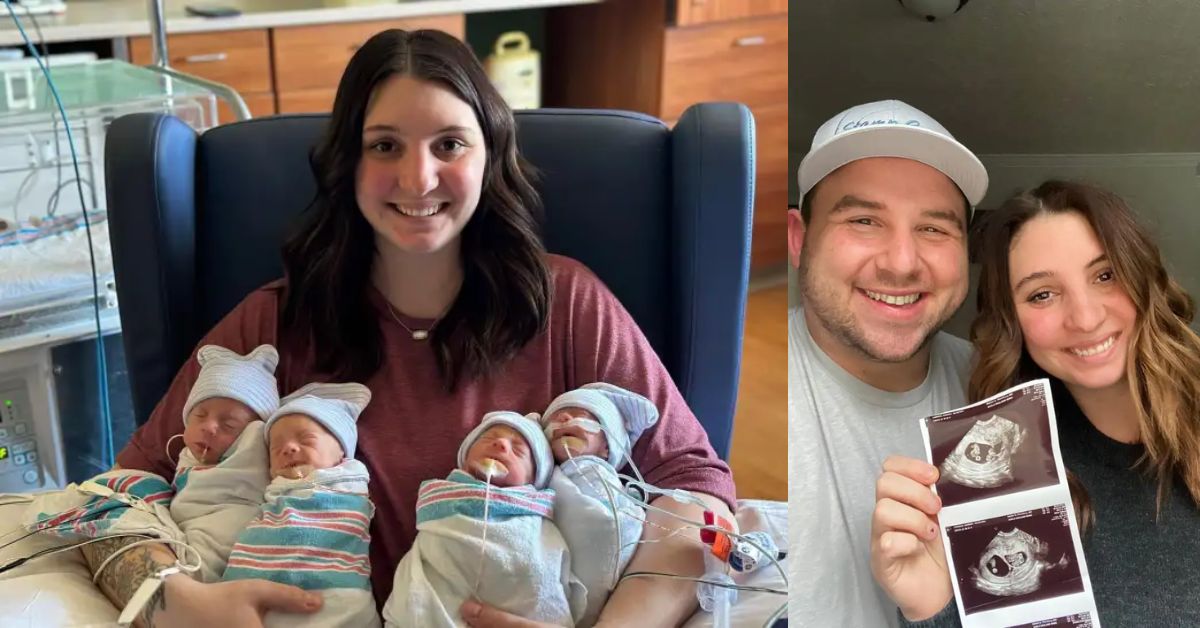
Parenting is often described as a series of negotiations. We negotiate with our toddlers to eat their peas, we negotiate with our teenagers about curfew, and sometimes, we negotiate with our spouses about the very size of our family.
For Michael and Hannah Carmack of Boaz, Alabama, the negotiation was simple, or so they thought. Michael, a veterinary technician with a heart for a big, bustling household, wanted one more child. Hannah, a pragmatic and loving mother to their 8-year-old daughter Emily, was hesitant. She knew the work, the sleepless nights, and the energy required to raise a human being.
Eventually, love won out. Hannah agreed. They would try for one more. Just one. A nice, even family of four.
But the universe, it seems, had a sense of humor-and a grander plan than either of them could have conceived.
What happened next is a story that defies statistical probability. It is a story of terror, faith, medical marvels, and a biology equation so rare that it only happens in one out of every 70 million pregnancies.
This is the story of the Carmack family and their “Soufflé” babies.
The Ultrasound That Stopped Time
There is a specific kind of silence that happens in an ultrasound room when something is “off.” Every parent knows the fear of that silence. You wait for the heartbeat. You wait for the tech to say, “Everything looks perfect.”
When Hannah and Michael went in for their first scan, Hannah was already nervous. She lay on the paper-covered table, gel on her stomach, watching the grainy black-and-white monitor.
She squinted. She saw a blob. Then another.
“Twins?” she asked, her voice pitching up slightly.
The ultrasound technician didn’t answer immediately. The wand kept moving, sliding across her belly with purpose.
Hannah’s heart began to race. “Is it three?” she asked, half-joking, half-terrified.
The technician stopped moving the wand. She turned, placed a gentle, steadying hand on Hannah’s knee, and delivered the sentence that would shatter their reality and rebuild it into something entirely new.
“Sweetie,” the tech said softly. “It’s four.”
The 1-in-70-Million Equation
In the world of obstetrics, quadruplets are rare. But usually, when we hear of high-order multiples, assisted reproductive technology (like IVF) is involved.
For the Carmacks, this was spontaneous. But the shock didn’t stop at the number four. It was how the babies were formed.
The scan revealed that Hannah had released two eggs. That in itself is the recipe for fraternal twins. However, in a biological twist of fate, both of those eggs split.
This meant they weren’t just having four babies; they were having two sets of identical twins. Two identical boys and two identical girls.
To put this in perspective: The odds of conceiving spontaneous quadruplets are rare. The odds of conceiving spontaneous quadruplets consisting of two sets of identical twins are roughly 1 in 70 million.
You have a better chance of winning the lottery or being struck by lightning than having the pregnancy Hannah Carmack was carrying.
The Grief of the “Normal” Life
We often talk about the joy of pregnancy news, but we rarely discuss the sheer panic that accompanies a shock like this.
Michael, the optimist who dreamed of a big family, started laughing. It was a nervous, incredulous laugh. He was watching his dream manifest in overdrive.
Hannah, however, burst into tears. And they weren’t immediately tears of joy.
“I do believe my heart grieved for a while after finding out,” Hannah bravely admitted in a Facebook post later. “I hated that I felt that way because I know so many people are out there trying to conceive and I got blessed with quadruplets.”
Her reaction was raw, honest, and entirely valid. She was grieving the life she thought she was going to have. She was grieving the simplicity of a family of four. She was thinking about the logistics—four car seats, four college tuitions, four mouths to feed simultaneously. She was thinking about her 8-year-old daughter, Emily, and how she would fit into this sudden crowd.
“How can I be a good mother to four newborns at once?” she wondered.
A Meeting of Faith
The Carmacks found themselves at a crossroads. The medical risks of carrying quadruplets are astronomical. The physical toll on the mother is immense. The financial burden is heavy.
Needing an anchor, they didn’t turn to a financial advisor or a doctor first – they turned to their pastor.
After the appointment, still shaking from the news, they arranged a sit-down with their church leader. They talked for over an hour. They poured out their fears, their inadequacy, and their shock.
“What I think Hannah came to realize is, ‘This is not normal,’” Michael explained. “‘We had been chosen for something by God.’”
That perspective shift changed everything. If the odds were 1 in 70 million, then this wasn’t an accident. It was an assignment. They left the church not with all the answers, but with peace. They were ready to face the mountain.
The Scary Reality of TTTS
The pregnancy progressed, but “high risk” doesn’t begin to cover it. Hannah was essentially carrying a litter, and the human body is designed for one.
Michael, utilizing his background as a vet tech, understood the medical nuances better than most dads. He became the family’s updater-in-chief, keeping friends and followers informed.
At week 17, the other shoe dropped.
The scan showed that one of the girls, Baby Adeline, was in trouble. She was measuring smaller than her sister, Evelyn, and had dangerously low fluid levels.
The doctors suspected Twin-to-Twin Transfusion Syndrome (TTTS).
This is a serious condition that affects identical twins who share a placenta. In simplified terms, there is a connection in the blood vessels where one twin (the donor) pumps blood to the other twin (the recipient). The recipient gets too much blood and fluid, overloading their heart, while the donor becomes malnourished and dehydrated.
“As they monitored the babies, they found that Adeline had irregular blood flow through her umbilical cord,” Michael wrote.
It was a life-or-death situation for the girls. The doctors had to act. They performed a delicate in-utero procedure to separate the blood vessel connections between Evelyn and Adeline, effectively stopping the transfusion.
It was a terrified waiting game, but the surgery was a success. Adeline was a fighter.
March 14: The Arrival
The goal with quadruplets is always to keep them in simply as long as possible. Every day inside the womb is a victory for lung development.
On March 14, 2023, at 27 weeks gestation, Hannah’s body decided it was time.
A C-section for quadruplets is not a standard operation. It is a military operation. There are teams of doctors and nurses for each baby, plus the team for the mother. The operating room was packed.
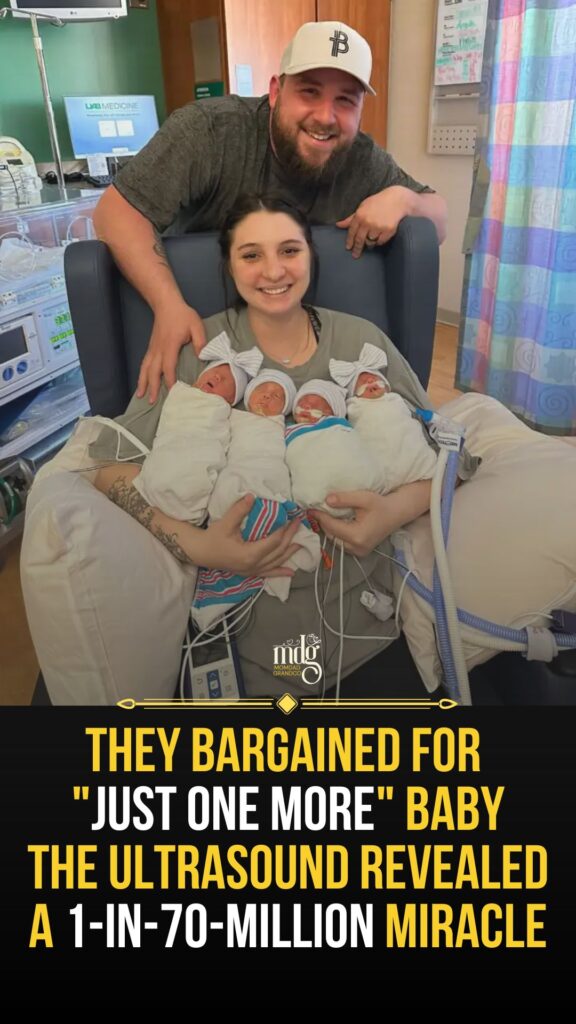
Within the span of four minutes, the Carmack family doubled, then tripled, then quadrupled in size.
- Evelyn (Girl, Set A)
- Adeline (Girl, Set A)
- David (Boy, Set B)
- Michael (Boy, Set B)
But the drama wasn’t quite over. When Adeline—the fighter who had already survived TTTS surgery – was pulled out last, the room grew tense.
She wasn’t moving. She wasn’t crying.
The umbilical cord was wrapped tightly around her neck.
“These babies are miracles. We knew this already, but this morning I learned that our sweet little Adeline is a fighter. She has always been one,” Hannah said later.
The medical team worked fast. They unwrapped the cord. They stimulated her small lungs. And finally, she breathed.
The NICU Marathon
Bringing home a baby is hard. Bringing home four premature babies is an ultramarathon.
The quadruplets were moved immediately to the Neonatal Intensive Care Unit (NICU). This began a new phase of life for the Carmacks: the hospital commute.
For 11 days, they couldn’t even see all their children together. They were in separate incubators, wired up to monitors, fighting to grow, to eat, to breathe.
Hannah, demonstrating the superhuman strength that mothers discover in crisis, didn’t stop. She was still working night shifts (a necessity for a family of seven), then spending her days at the hospital.
Michael watched his wife in awe. “Hannah persuades the nurses to let her hold more than one baby at a time because she knows how important it is for them to hear and feel her,” he shared. “She has a connection with these babies like no one else.”
The “Soufflé” Personalities Emerge
The couple affectionately nicknamed the group the “Soufflé babies” – because, like a soufflé, you need two eggs, and then they rise and expand.
By the time the babies turned two months old, still in the hospital but growing stronger, the unique dynamics of two sets of identical twins began to show.
Michael noted the fascinating pull between the siblings. Even as infants, they sought each other out.
“They’re in the same room and he’s always trying to get closer to her,” Michael laughed, describing Daniel and Adeline. “He loves her, and she’s like cutting her eyes at him. When we did skin-to-skin with them, she’d always be trying to inch away from him.”
Evelyn emerged as the sweet, smiley one. Adeline and Daniel, perhaps bonded by their rocky starts, showed dynamic, feisty personalities.
A New Definition of “Blessed”
Today, the Carmack house is loud. It is chaotic. It is filled with four times the diapers, four times the crying, and four times the laundry.
But it is also filled with four times the love.
Big sister Emily has stepped into her role with grace, helping her dad look after the brood. The shock of the ultrasound room has faded, replaced by the exhausting but rewarding reality of raising a miracle.
Hannah and Michael’s story is a testament to the fact that life rarely goes according to plan. Sometimes, you plan for a solo, and you get a choir.
They stopped asking “Why us?” in a tone of despair and started asking it in a tone of gratitude. Out of 70 million possibilities, the universe chose them.
As they look at their two sets of identical twins – living, breathing proof of the impossible – they know one thing for sure: They wouldn’t trade their chaotic, crowded, miraculous life for anything.
Join the conversation at MomDadGradCo:
Could you handle spontaneous quadruplets? What is the biggest surprise you’ve ever had during a pregnancy? Share your stories in the comments below!
Leave a Reply