

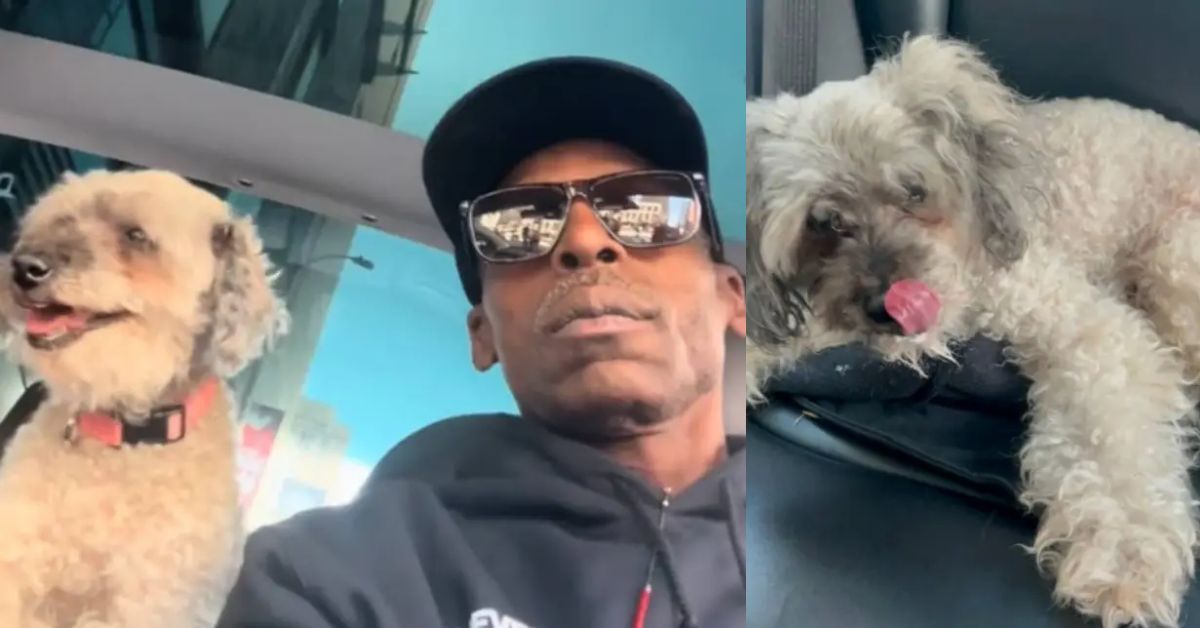
They say that time heals all wounds. They say that eventually, you move on, you forget, and you let go of the things that have slipped through your fingers. But anyone who has ever loved a dog knows that “moving on” is a myth. You don’t move on; you just learn to live with the empty space on the rug, the silence where the collar tags used to jingle, and the ghost of a wet nose against your hand.
For Edmon Lighthall, a 51-year-old resident of Chicago, that empty space lasted for a decade. Ten winters. Ten summers. Three thousand, six hundred and fifty days of wondering.
In a story that defies the odds and challenges everything we know about loss, Edmon proved that while time passes, love does not fade. After ten long years, his missing poodle-doodle mix, Peter, came home.
This isn’t just a story about a lost dog found. It is a story about the endurance of hope, the miracle of technology, and the unbreakable bond between a human and his best friend.
The Disappearance: A Decade of Silence
To understand the magnitude of this reunion, we have to go back ten years. The world was a different place. Edmon was younger. Peter was just a sprightly dog full of chaotic energy.
One afternoon, in what seemed like a blink of an eye, Peter vanished from Edmon’s backyard.
For pet owners, this is the nightmare scenario. It starts with a whistle. Then a shout. Then a frantic run through the neighborhood. You check the usual spots. You ask the neighbors. You post the flyers on telephone poles until the rain washes the ink away.
Days turn into weeks. The phone doesn’t ring. The leads dry up. Friends and family, well-meaning as they are, eventually stop asking. They start to use the past tense. Peter was a good dog.
But Edmon couldn’t switch to the past tense.
“I just felt deeply, a lot, for a long time, that we were inseparable in some way,” Edmon shared.
It’s a feeling known as “ambiguous loss” – a specific type of grief where there is no closure. Without a body or a definitive answer, the mind creates scenarios. Was he stolen? Was he taken in by another family? Was he safe?
For ten years, Edmon held onto a sliver of belief that defied logic. He told friends he would see Peter again. They likely nodded, patting his shoulder, thinking it was just denial. But Edmon knew his dog. He knew their connection wasn’t finished.
The Text Message That Stopped Time
Fast forward to January 2026. Edmon’s life had moved forward, but Peter was still a missing piece of the puzzle.
Then, the vibration of a phone changed everything.
It was a notification from a pet registry company. For many of us, these emails or texts are often spam or reminders to renew a subscription. But this message was different. It was an alert.
Peter’s microchip had been scanned.
Let that sink in. After a decade of silence, a digital ping announced life.
Edmon stared at the screen. Skepticism warred with adrenaline. Could it be a glitch? A mistake in the system? He immediately dialed the number provided, which connected him to Hammond Animal Control in Indiana, about 45 minutes away from his Chicago home.
A staff member answered. Yes, they had a dog. Yes, he was found wandering down a street by local police. Yes, the chip number matched.
Edmon didn’t wait. He didn’t ask for a photo. He got in his car.
The Longest 45-Minute Drive
The drive from Chicago to Hammond is a familiar route for many, but for Edmon Lighthall, it must have felt like an eternity.
What goes through your mind on a drive like that? You wonder what you will find. Ten years is a lifetime for a dog. Peter was young when he left; he would be a geriatric senior now – around 14 or 15 years old. Would he be sick? Would he be scared?
And the biggest fear of all: Would he remember me?
Science tells us that dogs possess associative memory. They remember places, scents, and people that have a strong emotional impact on them. But a decade? That is pushing the limits of biology.
Edmon gripped the steering wheel, his heart pounding against his ribs, hoping against hope that the bond was strong enough to bridge the gap of time.
The Reunion: A Smell, A Spin, A Bow
When Edmon arrived at the shelter on that fateful day, the air was thick with anticipation. The staff led him to the holding area.
The door opened.
And there he was. Older. Grayer. A little slower. But it was him. It was Peter.
“It was absolutely unbelievable,” Edmon told ABC News. “I saw Pete. He came out, he greeted me, and it was almost immediate. I felt like he recognized me immediately.”
It wasn’t just a wag of the tail. It was specific, idiosyncratic behavior that only a true owner would recognize. Peter performed a little spin, followed by a gentle, playful bow.
It was their secret handshake. It was the dog’s way of saying, Oh, there you are. I’ve been waiting.
The years melted away. The gray muzzle didn’t matter. The cloudy eyes didn’t matter. In that moment, they were just a boy and his dog again. Edmon fell to his knees, tears streaming down his face, as Peter pressed his head against him.
“I’m lucky to have him,” Edmon whispered, burying his face in the fur he hadn’t touched in ten years.
The Mystery of the Lost Years
One of the most haunting and fascinating aspects of this story is the mystery of the “Lost Decade.”
Where was Peter?
A dog does not survive on the streets of Chicago and Indiana for ten years on his own. He was fed. He was sheltered. It is highly likely that Peter was taken in by someone else – perhaps someone who found him and never checked for a chip, or perhaps someone who took him intentionally.
We will likely never know the full story of Peter’s odyssey. Did he have another name? Did he live in a house with kids? Did he escape again to find Edmon?
Whatever happened, fate – and a microchip – intervened. Peter ended up wandering the streets of Hammond, was picked up by the police, and for the first time in ten years, was scanned by a responsible agency.
It serves as a gentle reminder: if you find a stray dog, even if he looks well-fed, scan for a chip. You might be holding the answer to someone’s decade-long prayer.
The “Welcome Home” Party
Edmon didn’t just bring Peter home and lock the door. He understood that this miracle was meant to be shared.
He organized a “Welcome Home” party at a nearby park. It was a celebration of life. Friends and family gathered, some of whom remembered Peter from his puppy days, and some who had only heard the legend of the missing dog.
There were tears, laughter, and plenty of treats. Peter was introduced to his new “sister,” Bebe, and other family dogs.
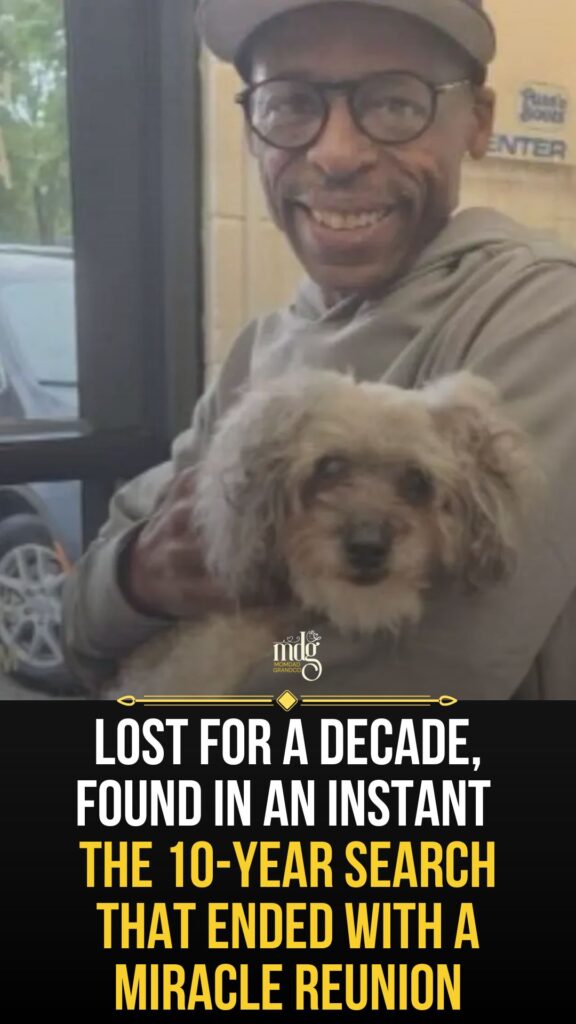
Photos from the event show Edmon beaming, a smile that reaches his eyes, carrying Peter in his arms like a baby. Peter, for his part, looks content. He is resting. He is home.
The Science Behind the Miracle: Why You Must Microchip
This story is emotional, but it is also a critical PSA. The Hammond Police Department and Animal Control used this moment to shout a message from the rooftops: Microchips work.
“This story is a perfect example of why microchipping works,” a spokesperson for the department said. “Even after ten years, this little guy was reunited with his family thanks to that tiny chip.”
A microchip is a glass cylinder, about the size of a grain of rice, injected under the loose skin between a pet’s shoulder blades. It is not a GPS tracker; it does not need a battery. It is a radio-frequency identification (RFID) implant. When a scanner passes over it, it transmits a unique ID number.
That number is the key. It links to a database with the owner’s phone number.
If Peter had not been chipped, he would have been just another stray senior dog in a shelter. Because of his age, he might have been deemed unadoptable. The chip literally saved his life.
The Takeaway:
- Chip your pets. It is inexpensive, painless, and permanent.
- Update your info. A chip is useless if the phone number linked to it is disconnected. Edmon clearly kept his contact info current, or the registry was able to track him down.
Loving a Senior Dog: The Final Chapter
There is a bittersweet beauty to this reunion. Peter is 15 years old. In dog years, he is a centenarian.
Edmon didn’t get back the spry dog that ran away. He got back an old man. He missed the prime years of Peter’s life. He missed the long walks in the summer, the games of fetch, the quiet evenings on the rug.
But Edmon doesn’t see it that way. He sees the time they have left.
Caring for a senior dog is a privilege. It is a time of soft beds, slow walks, and gentle petting. Edmon gets to provide comfort in Peter’s final chapter. He gets to ensure that Peter leaves this world knowing exactly who he is and where he belongs.
Peter is now “his shadow” again. He rests on his favorite spot on the couch, right beside Edmon. The circle is complete.
Why This Story Resonates Now
We live in a disposable world. We replace phones when the screen cracks. We ghost people when relationships get hard. We seek instant gratification.
Edmon’s story is the antidote to that culture. It is a story of persistence. It is a story of loyalty that asks for nothing in return.
He didn’t give up. He didn’t replace Peter. He held space in his heart, a vigil that lasted 3,650 days.
“I’m still amazed at how everything turned out,” Edmon says.
As we look at the photos of Edmon and Peter – the man with the kind eyes and the scruffy dog with the gray face – we are reminded to hold our loved ones a little closer. We are reminded to check the gates, check the microchips, and never, ever underestimate the power of love to find its way home.
Welcome home, Peter. You were missed.
Join the conversation at MomDadGradCo:
Has a microchip ever saved your pet? Have you ever experienced a miraculous reunion? Share your stories in the comments below and don’t forget to check your pet’s registration today!
Leave a Reply