

There are nightmares that you wake up from, shaking and sweating, only to realize the sun is shining and you are safe in your bed. And then, there are nightmares that do not end when you open your eyes. For Alta Apantenco and Jeffrie Highsmith, the nightmare began on a humid August day in Fort Worth, Texas, in 1971.
It was a nightmare that would last for 18,000 days.
It is a story that sounds like the plot of a Hollywood thriller, yet it is the terrifying, heartbreaking, and ultimately miraculous reality of the Highsmith family. It is a story about a mother’s worst fear, a father’s undying hope, and the incredible power of modern science to heal wounds that were half a century old.
This is the story of Melissa Highsmith, the toddler who was taken, and the woman who finally came home.
August 23, 1971: The Day the Clock Stopped
To understand the depth of this tragedy, we must transport ourselves back to 1971. It was a different era—a time before Amber Alerts, before the internet, and before DNA databases. It was a time when neighbors trusted neighbors, and a handshake was a contract.
Alta Apantenco was a young mother, working hard to make ends meet as a waitress. Like so many parents then and now, she faced the eternal struggle of finding reliable childcare. Desperate for help so she could keep her job, she placed an advertisement in the local newspaper seeking a babysitter for her 21-month-old daughter, Melissa.
A woman answered the ad. She sounded polite, professional, and eager to help. She agreed to meet Alta at the restaurant where she worked, but she never showed up. Later, the woman called back, apologizing profusely, claiming she had a large yard and a nice house where she cared for other children.
Alta, needing to work, agreed to let the woman pick Melissa up from her apartment.
When the “babysitter” arrived at the apartment complex, Alta was already at her shift. Melissa was in the care of Alta’s roommate. The woman who knocked on the door was dressed impeccably. She wore a nice dress and, most memorably, a pair of white gloves.
To the roommate, the white gloves signaled sophistication and care. She handed the 21-month-old toddler to the woman.
The woman in the white gloves walked away with Melissa. And she never came back.
The Longest Silence
When Alta returned home and realized her daughter was gone, panic set in. The police were called. The search began. But in 1971, without digital footprints or surveillance cameras, the trail went cold almost immediately.
The “babysitter” was a ghost. The name she gave was likely false. The description—a well-dressed woman in white gloves—was all they had.
For the Highsmith family, the days turned into weeks, the weeks into months, and the months into decades.
But the pain wasn’t just the loss of a child; it was the judgment of a community. In the absence of clues, suspicion turned inward. The police and the public often looked at Alta with skepticism. How could you let a stranger take your baby?
For 51 years, Alta lived with the crushing weight of guilt and the whispers of accusation. There were rumors that she had harmed the child, or sold her. She was a grieving mother who was denied the sympathy she deserved because the world needed a villain, and the woman in the white gloves had vanished.
“My mom did the best she could with the limited resources she had,” Melissa’s sister, Sharon Highsmith, said years later. “She couldn’t risk getting fired, so she trusted the person who said they’d care for her child.”
The Birthday Parties for a Ghost
Most families would eventually try to “move on.” They would pack away the photos and stop talking about the missing child to spare themselves the pain.
The Highsmiths were not most families.
They went on to have other children—Jeffrie and Alta eventually separated, but both built lives—but Melissa remained a present figure in their households.
Every year, on Melissa’s birthday, the family threw a party. They bought a cake. They lit candles. They sang “Happy Birthday” to an empty chair. It was an act of defiance against despair. It was their way of telling the universe, We have not forgotten. She is still ours.
They created a Facebook page, “Finding Melissa Highsmith.” They chased leads. They drove across state lines whenever a tip came in, only to have their hearts broken again and again.
But they never stopped looking.
The Science of Miracles
By 2022, the case was as cold as ice. The police files were dusty. The detectives who originally worked the case were retired or passed on.
But while the official investigation had stalled, technology had advanced. The era of consumer DNA testing—23andMe, AncestryDNA—had arrived.
Jeffrie Highsmith, Melissa’s father, decided to take a DNA test, not necessarily to find Melissa, but to learn about his heritage. He uploaded his results to a database.
The results that came back were confusing. The system alerted him to a match. Not a distant cousin or a great-uncle.
It was a match for grandchildren.
Three children—two boys and a girl—shared a significant amount of DNA with Jeffrie. He didn’t know who they were. He knew his known children and their offspring. These were strangers.
The family realized they were standing on the precipice of something massive. But they needed help to interpret the data. They called Lisa Jo Schiele, a clinical laboratory scientist and amateur genealogist who had a knack for solving genetic puzzles.
The Digital Detective
Lisa Jo Schiele looked at the charts. The math was undeniable.
“I came in and tried to look at if there were any other possibilities besides these being such close matches to Melissa,” Schiele explained. “And it didn’t take me long to realize—I mean, I knew right away that there wasn’t.”
The three strangers were Melissa’s children. Which meant Melissa was alive.
The team worked backward. They identified the adoptive father of the three children. Through him, they found a Facebook profile for a woman named Melanie Miyoko.
The family stared at the screen. The woman in the photos looked like them. She had the Highsmith eyes. She had the smile.
Trembling, they sent a message via Facebook Messenger.
“I Think You Are Our Daughter”
Imagine receiving a message on Facebook from strangers claiming that your entire life is a lie. That is what happened to Melissa (known as Melanie) in November 2022.
At first, she was skeptical. She thought it was a scam. She had a mother. She had a childhood. She wasn’t “missing.”
But the Highsmiths had details. They asked her if she had a specific birthmark on her back.
Melissa went to a mirror. She checked. There, on her back, was the mark they described.
“I feel like I am dreaming, and I keep having to pinch myself to make sure I’m awake,” Melissa said later.
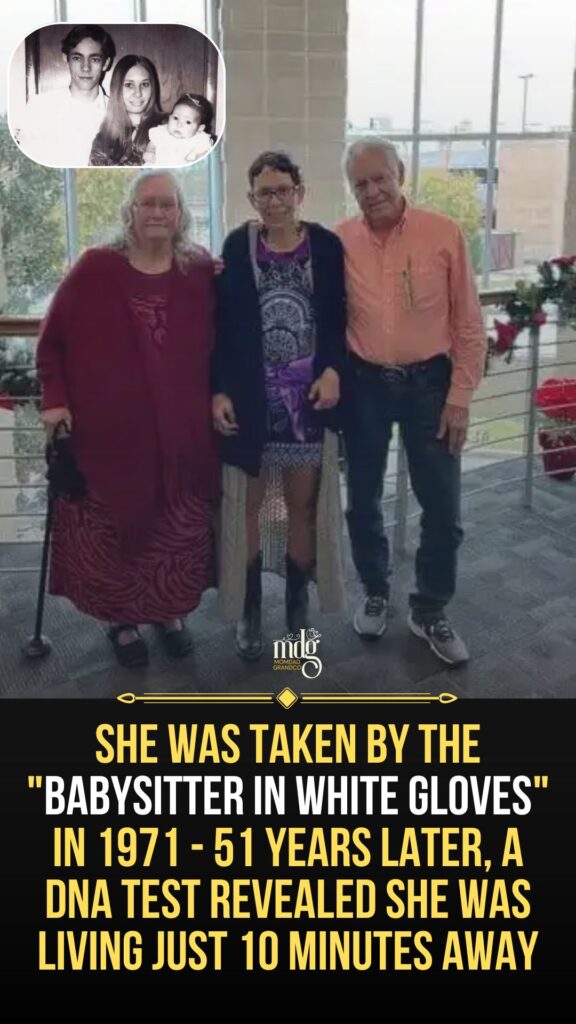
She agreed to take a DNA test to confirm what the birthmark and the algorithms already knew. The results came back 100% positive. Melanie Miyoko was Melissa Highsmith. The baby taken 51 years ago.
The Cruel Twist: She Was Right There
As the truth unraveled, a shocking detail emerged that left the family reeling.
Melissa had not been taken to a foreign country. She hadn’t been moved to the other side of the United States.
She was raised in Fort Worth, Texas.
For 51 years, Melissa had lived just 10 minutes away from her biological mother’s apartment. She had likely shopped at the same grocery stores. She might have passed her biological siblings in the mall.
The woman who raised her—the woman Melissa now believes was the “babysitter”—had simply taken her, renamed her, and raised her a few miles down the road.
Melissa revealed that her childhood was not a happy one. She had run away from home at 15. She described her relationship with the woman who raised her as abusive and strained. She had always felt out of place, but she never suspected she was a kidnapped child.
The Reunion: 51 Years in the Making
On a Saturday in November 2022, the moment finally arrived.
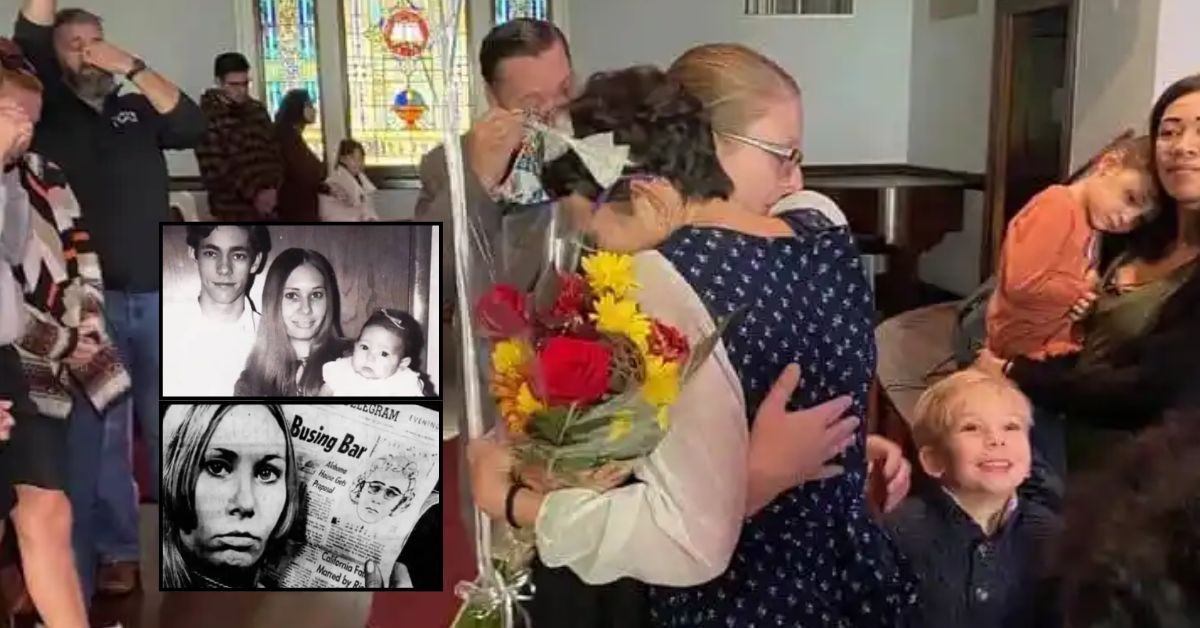
At a church in Fort Worth, the doors opened. Melissa walked in.
There are no words to adequately describe the sound of a mother weeping for a child she hasn’t held in 51 years. Alta, now elderly, collapsed into her daughter’s arms. Jeffrie, the father who never stopped searching, cried openly, his face buried in his hands.
“I just couldn’t believe it,” Alta said through tears. “I thought I’d never see her again.”
Melissa, overwhelmed, looked at the sea of faces—sisters and brothers she never knew she had. They touched her face, her hair, needing to prove to themselves that she was real.
“It was so overwhelming, but at the same time, it was just the most wonderful feeling in the world,” Melissa told Good Morning America.
Vindication for a Mother
Beyond the joy of the reunion, there was a profound sense of justice for Alta.
For five decades, she had lived under a cloud of suspicion. The community had whispered. The police had doubted.
“My mom has carried this guilt for 51 years,” said Sharon, Melissa’s sister. “She’s been accused of selling her baby. She’s been accused of killing her baby.”
With Melissa standing there, alive and telling her story, Alta was finally exonerated. She hadn’t done anything wrong. She had been the victim of a predator who took advantage of a young mother’s need to work.
“I’m grateful,” Sharon added. “We have vindication for my mom.”
The “Mom” Who Stole a Life
The reunion brought joy, but it also brought anger. Melissa confronted the woman who raised her on Facebook.
According to Melissa, the woman admitted to knowing she was not her biological child but claimed she had “bought” her on the street for $500.
Melissa doesn’t buy that story. She believes the woman who raised her is the same woman who wore the white gloves in 1971.
Frustratingly, the legal system can offer little in the way of criminal justice. The statute of limitations for the kidnapping expired decades ago. In Texas, and many other states, there are time limits on prosecuting crimes, even ones as heinous as abduction.
However, the Highsmith family has stated that while the legal door may be closed, their focus is on the emotional door that has just opened. They are not wasting energy on the kidnapper; they are spending it on each other.
A New Chapter: Walking Down the Aisle
Melissa is wasting no time reclaiming her identity. She plans to legally change her name back to Melissa.
But the most heartwarming plan involves a wedding.
Melissa is already married to her husband, but she wants to renew her vows. Why? Because she wants her father, Jeffrie, to walk her down the aisle.
She wants her biological sisters to be her bridesmaids. She wants her mother to sit in the front row. She wants to rewrite the history of her life, replacing the memories of a stolen childhood with new memories of a family made whole.
Why This Story Matters
The story of the Highsmith family is a beacon for every family currently searching for a missing loved one.
It reminds us that “cold cases” are only cold until one person decides to light a match. In this case, that match was a DNA test.
It challenges us to look at the “unsolved” mysteries of the world and realize that answers are out there.
And mostly, it validates the intuition of a parent. Alta and Jeffrie never stopped believing. They kept the flame alive for 51 years. They prove that a parent’s love does not adhere to the laws of time or probability.
Melissa Highsmith was lost. But because her family refused to let go, she was never truly forgotten.
Join the conversation at MomDadGradCo:
Have you used a DNA kit to discover family secrets? Do you think the statute of limitations should be removed for kidnapping cases? Share your thoughts and stories in the comments below.
Leave a Reply