

There are moments in life that define who we are. Sometimes, they happen in the grand gestures of a lifetime, but more often, they happen in the quiet decisions we make on a Tuesday afternoon. They happen when we look at our children, look at the world they are inheriting, and decide that we have to do something—anything—to make it a little softer.
For AJ Owen, a father from Pittsburgh, that moment came in late October 2025. It was a time of national anxiety. The news cycle was dominated by the government shutdown, then entering its grueling 38th day. But for AJ, the headlines weren’t just abstract political drama; they were a reality that was hurting his neighbors. With the Supplemental Nutrition Assistance Program (SNAP) benefits disrupted for an estimated 42 million Americans, the safety net was fraying. Families were looking at empty cupboards and wondering where the next meal would come from.
AJ Owen didn’t have a foundation. He didn’t have a government grant. He didn’t have a team of logistics experts. He had $150, a Toyota filled with two eager young sons, and a front yard.
What happened next would not only feed a neighborhood but would ripple across the internet, culminating in a moment by a mailbox that left a grown man shaking, crying, and reminding us all of what it truly means to be a neighbor.
The Conversation That Started It All
It began, as so many important things do, with a conversation between a parent and his children.
AJ’s sons, ages 7 and 9, are at that inquisitive age where they absorb the energy of the world around them. They knew things were tense. They knew people were struggling. In the Owen household, shielding kids from reality isn’t the goal; equipping them to handle it is.
“I try to keep my kids updated on what’s happening in the world,” AJ told People Magazine. “But they’re helpers. They’ve always been helpers.”
When AJ explained the situation—that the government assistance many families rely on was potentially vanishing and that food might become scarce for people down the street—the boys didn’t ask why the government wasn’t fixing it. They didn’t ask whose fault it was. They asked the only question that matters in a crisis:
“How can we help people?”
For AJ, the answer was simple. You don’t wait for permission to be kind. You just go.
“This was the answer,” AJ said.
The $150 Haul and the Fear of Failure
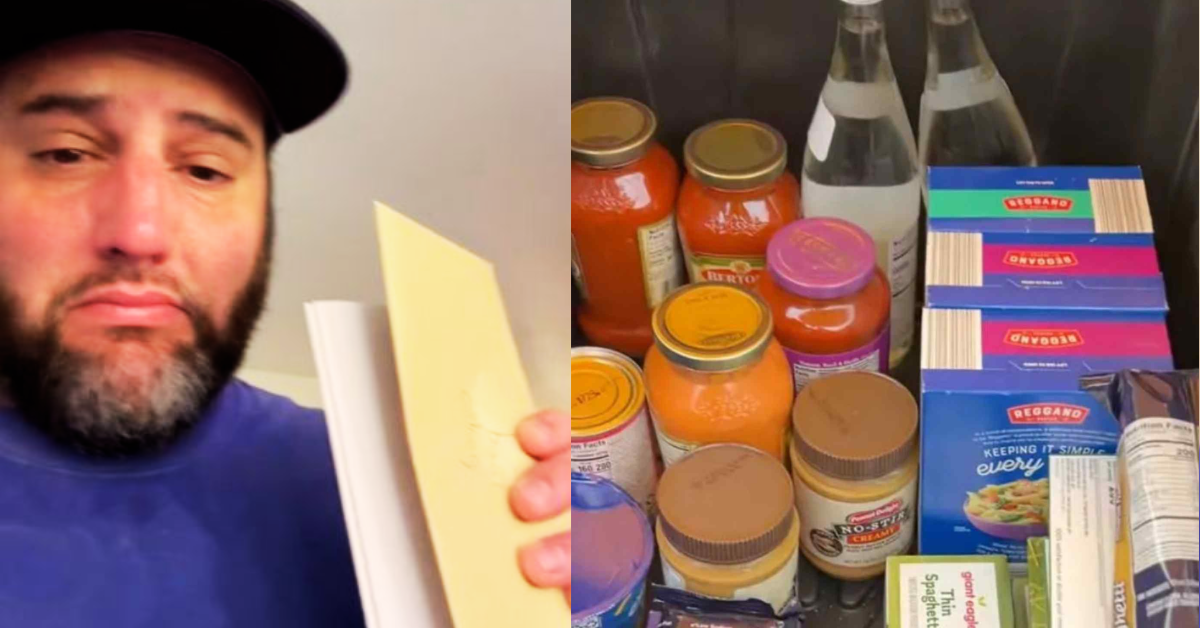
On Sunday, October 26, the Owen men went on a mission. They marched into their local grocery store not to shop for their own dinner, but to shop for strangers. They filled their cart with the essentials: pasta, sauce, canned vegetables, baby formula, shelf-stable milk—the building blocks of survival.
The bill came to $150. For a regular family, that is not an insignificant amount of money. It’s a sacrifice. But AJ swiped his card, loaded the bags, and drove home to set up shop.
They arranged the items on a table in their front yard. It wasn’t fancy. There was no ribbon-cutting ceremony. It was just food, sitting out in the crisp Pennsylvania air, available to anyone who needed it.
But as they set up the cans and boxes, a shadow of doubt crept in. AJ’s youngest son looked at the display and voiced a fear that plagues every person who has ever tried to do something good: What if nobody comes? What if we did this for nothing?
It’s a valid fear. Pride is a powerful barrier. Would neighbors be too embarrassed to take food from a front yard? Would the gesture go unnoticed?
AJ knelt down and gave his son a lesson that should be printed in every parenting handbook in America.
“Buddy,” he said, looking him in the eye. “If we help one person, then this was all worth it.”
The Power of “The Helpers”
AJ decided to document the journey on TikTok, not for clout, but to spread the word to locals. He posted a video of the setup, the goods, and the intention behind it.
In the digital age, algorithms are often blamed for spreading division. But sometimes, the algorithm finds the light. AJ’s video didn’t just reach his neighbors; it reached the heart of the country.
Overnight, the video exploded. It wasn’t just the sight of free food that grabbed people’s attention; it was the spirit of the thing. It was the “Mr. Rogers” energy—fitting for a Pittsburgh native. Fred Rogers famously told us that in times of scary news, we should “look for the helpers.”
AJ and his boys were the helpers.
The comments section became a testament to the goodness of strangers. People asked how they could Venmo him. People asked for the address to drop off their own donations. The fear that “nobody would show up” was quickly replaced by the reality that everybody wanted to be involved.

The Envelope That Stopped Time
By November 1, the “Owen Family Pantry” was in full swing. Neighbors were taking what they needed, and others were leaving what they could. It was a functioning ecosystem of kindness.
But nothing could have prepared AJ for what was waiting in his mailbox.
He walked out to check the mail, expecting bills or flyers. Instead, he found a thick, unmarked envelope. It had no return address, no name attached to the sender. Just a simple, handwritten note inside:
“May God prosper and bless your food pantry.”
AJ stood in his driveway, the November wind biting at his cheeks, and opened the envelope.
“I took the envelope in; it felt thick. I thought maybe there’s some gift cards in there,” AJ recalled later.
He was wrong. It wasn’t gift cards.
Inside was a stack of hundred-dollar bills. Thousands of dollars in cash.
In a video that has now been viewed over 18 million times, the world watched a father break down. He didn’t cheer. He didn’t jump up and down. He froze. The weight of the generosity hit him physically.
“I opened it up and just—hundred-dollar bills,” he stammered, tears streaming down his face into his beard. “I truly didn’t know how to react. I froze. I started shaking and I started crying.”
It wasn’t just money. It was fuel. It was a message from the universe—or from a very generous neighbor—that he was on the right track. It was validation that when you step out in faith to help your community, the community steps up to hold you.
“Humanity is Showing Up”
The video of AJ’s reaction is raw and unfiltered. It captures a man overwhelmed by the realization that he is not alone in his desire to do good.
The internet responded with a collective emotional release. In a year defined by political bickering, court battles over funding, and economic uncertainty, seeing a man cry over a donation to feed strangers was the catharsis everyone needed.
“Humanity is showing up,” one viewer commented. “This gives me hope.”
Another wrote, “I remember when Mr. Rogers told me to look for the helpers. You found them, and they found you.”
But the most powerful comments were the ones that indicated action. The “ripple effect” began to take hold. AJ’s $150 investment wasn’t just feeding his street; it was inspiring people thousands of miles away to look at their own neighborhoods with fresh eyes.
“This reminded me there’s a food pantry really close to me I haven’t helped stock in a bit,” one user wrote. “Gonna fix that now.”
Another shared, “I delivered about 10 bags of groceries that myself and my friend pulled together today to a food pantry nearby. The place was fully packed. This is my America.”
This is the viral nature of goodness. Cynicism is contagious, but so is hope. And hope moves faster.
Steel City Solidarity
As the pantry grew, fueled by the cash donation and the influx of supplies from inspired locals, another surprise was in store.
Pittsburgh is a city that bleeds black and yellow. The Steelers aren’t just a football team; they are a religion. So, when a massive figure approached the Owen front yard, AJ might have done a double-take.
It was Yahya Black, the defensive end for the Pittsburgh Steelers.
The NFL player hadn’t come for a photo op. He came to work. He dropped off supplies, adding his strength to the community pile. For AJ and his boys, die-hard fans of the team, it was a collision of their two worlds.
“Look at this!” AJ said in a follow-up video, grinning from ear to ear as he panned the camera over a mountain of grocery bags that now dominated his yard. “This is going to last so long. And I’m so grateful they showed up.”
It was a reminder that community service levels the playing field. Whether you are a defensive lineman making millions or a dad putting $150 on his credit card, the goal is the same: taking care of the home team. And the home team is everyone.
Destigmatizing the Ask
Perhaps the most important part of AJ Owen’s mission is the way he frames the act of receiving help.
Food insecurity carries a heavy stigma in America. Parents often starve themselves so their children can eat, simply to avoid the “shame” of standing in a breadline. AJ is working hard to dismantle that shame, one TikTok at a time.
His philosophy is simple and radical in its hospitality.
“Making a food pantry is no different than me inviting you over to my house for dinner,” Owen explained. “Come grab a meal. Come grab a drink. Come grab what you need. I’m happy to have you.”
By reframing charity as hospitality, he strips away the hierarchy. It isn’t a transaction between the “haves” and the “have-nots.” It is a sharing between equals. It is a neighbor saying, I have extra pasta this week, and you might need it. Next week, it might be the other way around.
“People deserve food, people deserve to be fed,” he stated firmly. “As long as there’s a need in our community, we will keep this out.”
The Lesson for Us All
As we move toward the end of 2025, the story of AJ Owen and his family serves as a beacon. The government shutdown and the SNAP cuts are complex, macro-level problems that feel impossible for an individual to solve. It is easy to look at the news, feel paralyzed by the scale of the suffering, and do nothing.
AJ Owen proves that we don’t need to solve the whole problem to make a difference. We just need to solve the problem for the person standing in front of us.
We don’t need thousands of dollars in an envelope to start (though it certainly helps). We need the willingness to look at our resources—whether that’s $150, a few cans from the back of the pantry, or just an hour of our time—and ask, “How can I turn this into help?”
We need to teach our children, as AJ has, that when the world gets scary, we get busy. We don’t hide; we help.
The Owen family front yard is no longer just a patch of grass. It is a monument to the American spirit. It is a place where a defensive end drops off beans, where anonymous strangers drop off stacks of cash, and where a father teaches his sons that love is a verb.
So, the next time you feel overwhelmed by the state of the world, remember the shaking dad in Pittsburgh. Remember the envelope. And remember that you, too, have something to give.
As AJ told his son: If we help one person, then this was all worth it.
How You Can Help in Your Community:
- Locate a Micro-Pantry: Check for “Little Free Pantries” or “Blessing Boxes” in your neighborhood.
- Donate Cash: Local food banks can stretch a dollar much further than you can at the grocery store due to wholesale agreements.
- Check In: Simply knocking on a neighbor’s door to check in can uncover needs that aren’t visible from the street.
Share this story to inspire others to be the “helpers” we need right now.
Leave a Reply