

Sometimes, life doesn’t wait for the perfect moment. A student might be balancing family, work, and school, all while navigating challenges that most people can’t even imagine. And sometimes, a small act of kindness can make all the difference in someone’s life.
This is the story of Sarah Thompson, a young mother, and Dr. Josie Ryan, a college professor whose empathy and support allowed a student to continue her education without sacrificing her role as a mother.
A New Mother and a Challenging Semester
Sarah Thompson was excited to begin her mathematics course at Lander University in Greenwood, South Carolina, but life had a surprise in store. Just a week into the semester, she gave birth to her son, Isaiah.
Suddenly, the delicate balance of attending classes, learning complex mathematical concepts, and caring for a newborn became her reality. For many new mothers, this situation can feel impossible. Sleep-deprived nights, endless feedings, and the demands of a tiny human make returning to school feel overwhelming, if not impossible.
Sarah faced this challenge head-on, determined not to let motherhood stop her from achieving her educational goals. But the fear of missing class, falling behind, or worrying about her baby’s care added immense stress.
A Professor Who Truly Saw Her Student
Dr. Josie Ryan, Sarah’s mathematics professor, understood the difficulty of Sarah’s situation. She could have simply told her student to take time off, struggle with childcare arrangements, or try to find a solution herself. But Dr. Ryan took a different approach – one that was both rare and beautiful in its simplicity.
She told Sarah:
“Bring Isaiah to class.”
For Sarah, the idea was initially intimidating. Who brings a newborn to a college class? Would other students mind? Could she focus on learning while caring for her baby?
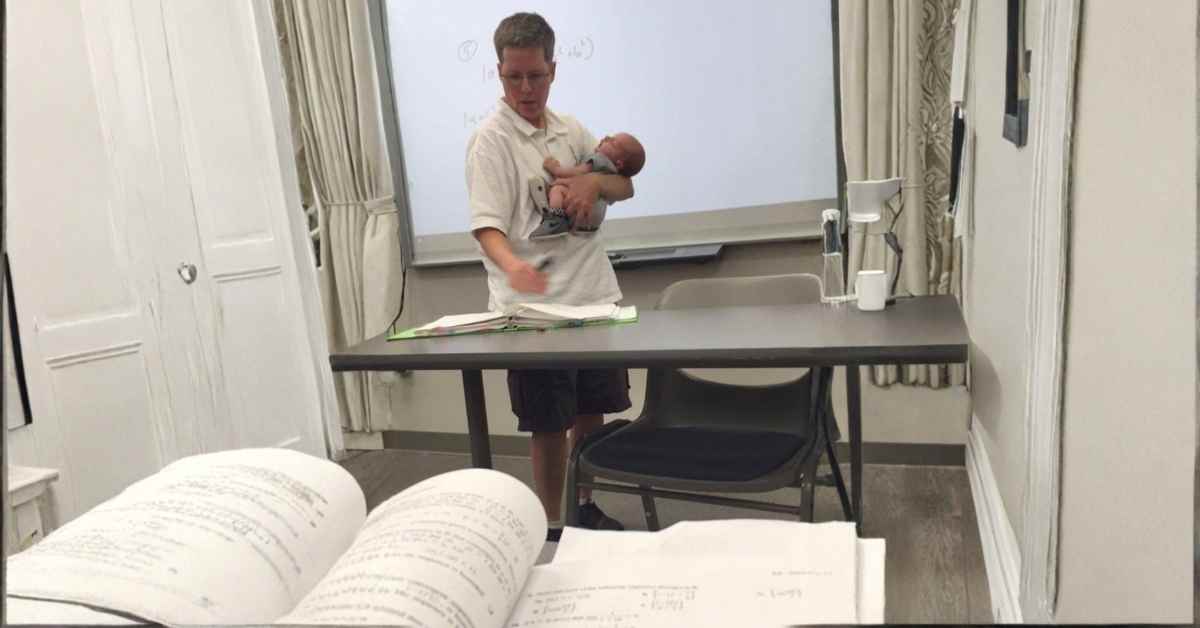
Dr. Ryan reassured her. She showed Sarah where the breastfeeding room was on campus, explained that it was completely acceptable to have her baby present, and even offered to hold Isaiah herself during the first class.
This act of compassion removed an enormous burden from Sarah’s shoulders. She didn’t have to worry about leaving her newborn at home, arranging last-minute childcare, or missing out on critical lessons. She could attend class, learn, and still be a present mother.
More Than Just a Teacher: A Mentor and Supporter
Sarah later wrote on Facebook about her experience:
“It’s so reassuring to know that there are professors out there like this. Not only is she an amazing person, she’s also one of the best math professors I’ve ever had.”
Dr. Ryan’s actions went beyond academic duty. She became a mentor, a supporter, and a reminder that empathy in education can transform lives. For students juggling parenthood, financial pressure, and schoolwork, a little understanding goes a long way.
Sarah’s story isn’t just about one young mom and one kind professor. It’s a lesson for educators, institutions, and families everywhere: the path to education doesn’t have to be blocked by circumstances.
The Power of Community and Support
Sarah acknowledges that she couldn’t have done it alone. In addition to Dr. Ryan’s support, her family stepped in to help, providing the care, encouragement, and practical help needed to manage both her studies and motherhood.
She wrote:
“Our families are beyond supportive of my decision to graduate within the first year of his birth, and I couldn’t do this without them. It’s hard – but with support like this, how can I lose if I trust God & believe in myself?”
Support doesn’t always come in the form of money, gifts, or time. Sometimes, it comes as acceptance, encouragement, and understanding.
For Sarah, knowing that her professor saw her potential, respected her role as a mother, and provided a safe space for her baby created a ripple effect. It allowed her to focus, learn, and thrive in a challenging environment.
A Lesson for All Educators
Dr. Ryan’s decision reflects a broader truth about education: students are people first. They have lives, responsibilities, and challenges beyond the classroom. When educators take the time to understand and accommodate those realities, incredible things can happen:
- Students succeed academically because they feel supported rather than judged.
- Confidence grows, not just in the subject matter but in life skills and decision-making.
- Communities are strengthened, as acts of kindness inspire others to be compassionate.
Sarah’s story can serve as a guide for other educators who want to make their classrooms inclusive and supportive.
Motherhood and Education: Breaking Barriers
Many young parents face the harsh reality of having to choose between education and family. For mothers, especially, the challenges are compounded by societal expectations, limited resources, and the physical demands of caring for a newborn.
By allowing Sarah to bring her son to class, Dr. Ryan didn’t just offer convenience. She sent a powerful message:
Your role as a mother does not have to prevent you from pursuing your dreams.
This message resonates with mothers everywhere who have faced similar crossroads. For those with young children, pursuing higher education can feel daunting – but it is possible with supportive networks, understanding educators, and practical solutions.
A Community of Care
The classroom, often seen as a sterile environment of rules and grades, became for Sarah a safe space of empathy and understanding.
Her classmates witnessed the act of kindness firsthand. They saw a professor who treated her student as a whole person, not just a grade. They observed a classroom that accommodated life, rather than forcing life to fit into rigid rules.
These subtle lessons – compassion, empathy, and humanity – often leave a deeper mark than any textbook or lecture.
Why Stories Like This Matter
Stories like Sarah and Dr. Ryan’s are worth sharing because they remind us of the humanity in everyday life. They encourage educators to be flexible, parents to persevere, and communities to support one another.
Sarah’s story also illustrates that support doesn’t have to be complicated or expensive. A simple gesture – allowing a student to bring a baby to class, pointing out a breastfeeding room, holding the infant for a few minutes – can have a life-changing impact.
Looking Forward
Sarah Thompson went on to continue her studies while caring for Isaiah. She credits her professor’s support as a key reason she could manage both responsibilities.
For Dr. Ryan, this was a natural choice – an example of seeing students as people, not just numbers or grades. Her empathy shows that sometimes, the most impactful lessons are not found in textbooks but in how we treat one another.
Leave a Reply